
Interview with Larisa Cheladyn by Mandy Eve-Barnett
1. What was the motivation for you as a young person going into painting?
The first instance I can remember is painting Easter eggs; however, I was also fortunate
to live in a home filled with art supplies. My father, a graphic artist, allowed me the
freedom to experiment with his supplies, and there were always art collections in the
house. He encouraged creativity in many forms, including the use of the first felt pens.
When asked about options at school, I chose art and was encouraged to follow that passion. 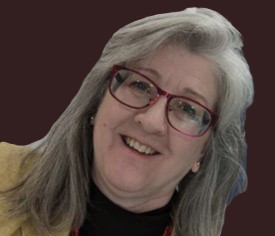
2. How do the different paint mediums change perspective?
With acrylics I find abstracts work best in simplifying the details and it is easier to plan
the image. In contrast, I love watercolours as they give rise to more details. There is a
balance of what I can dictate what the painting does, but it also accommodates happy
accidents, where the paint bleeds. Personally, I find pastels messy and I lack the ability
to create details. Using a pencil allows for lots of detail, such as in still-life artwork. I use Yupo
paper, which is a non-porous, acid-free, and pH-neutral synthetic paper, to enhance the
subject.
3. What propelled you to intersect the environment, humanity, religion, and wildlife in
your artwork?
As a child, I visited my grandparents’ farm throughout the seasons and accompanied my
father’s parents on camping trips. In the 1960s, my father’s sister, a child of the sixties,
lived in a self-sustaining home and inspired me with her knowledge and her embrace of
wildlife and nature. So I absorbed the beauty of the natural world. Coupled with this, we
had a copious number of pets. Later in life, I discovered our family had Ukrainian
ancestry. In addition, my Ukrainian heritage and cultural connection to nature had an
ongoing presence in our family life, giving me another avenue to portray. explore.
These various subjects give rise to learning and experimentation, which I enjoy.
For example, with my Flowers of the Americas artwork, I portrayed endangered
orchids on a solo six-country touring exhibition co-sponsored by the World Wide Fund
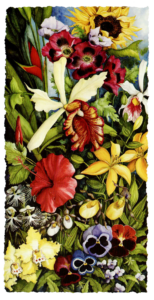
Flowers of the Americas by Larisa Cheladyn
for Nature (WWF). While my Flowers of the Bible collection included imagery from my
Ukrainian heritage and other religions common to the earlier text.
4. How important is the representation of different cultures in art?
I feel art is painted for an audience I will never see. It is a statement and also a
communication of lifestyle, perspective, and the past and future of cultures in a non-
biased celebration.
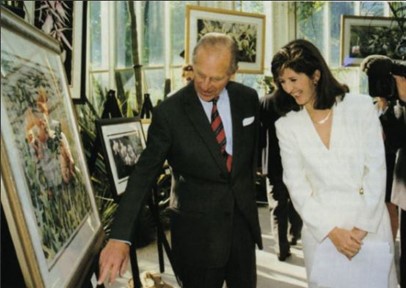
5. Can you relay how the World Wide Fund for Nature exhibit in 1996 affected you and
your art career?
In the art world, becoming well known outside of Canada afforded me recognition
among elite artists and a new global audience, which in turn resulted in my work being
priced differently. My confidence grew, and I came to love research into topics for my
images, which included various cultures as well as nature-inspired pieces. This, in turn,
gave me the opportunity to create another significant exhibition in 2008 as a feature
artist with Dance Me, at the International Leonard Cohen Festival.
6. What did you learn about visual medium when using digital, projection imagery and
other multimedia?
I have used video to show the evolution and process of a painting in exhibits and as an
educational tool. Seeing the intricacies of how an image is created rather than just
viewing the finished piece gives the image a whole other aspect perspective and
appreciation. I do use my computer and phone sketch apps to doodle, which allow me
to edit and reconstruct prior to putting paint on a canvas. However, the physicality of a
painting rather than a digital representation brings more appreciation to the work.
7. When travelling around the globe how do the different cultures impact your
perspective?
For me, I mainly notice the colours, and how other cultures live. They use styles and
techniques in artwork, which gives me a library of ideas to experiment with. It is
important though to respect and learn those techniques without appropriation.
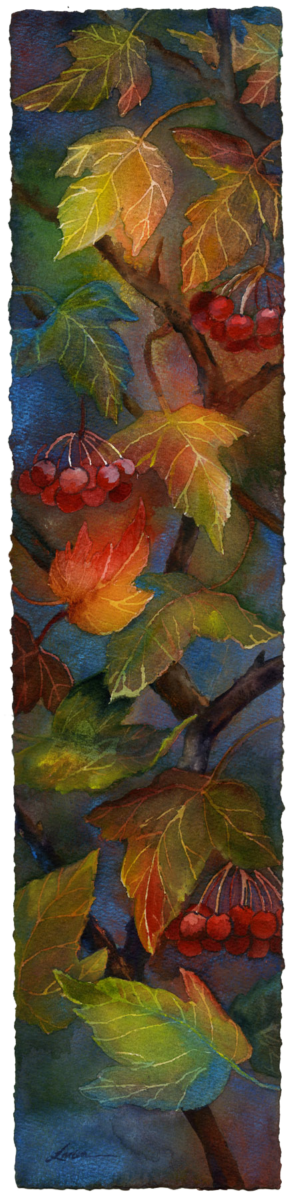
Kalyna by Larisa Cheladyn
8. What surprised you and what did you learn from teaching art classes?
When I am hosting classes, I have noticed how stifled young students are by teachers,
who expect them to ‘stay inside the lines’ rather than encourage creative
experimentation. This structuring does not allow the students to be open to ideas and
learn how the different art mediums work. For example, given a three-panel storyline of
beginning, middle and end, one young student created a flowing image across all three
panels and was told it was wrong. I advised the teacher that the student’s interpretation
was more important than the strict structure.
9. How important is it to mentor young talent?
Mentoring does take time and energy away from my work, but helping a student to find
their niche and allowing them the enthusiasm to follow their path is very satisfying.
10. Which accomplishment(s) are you most proud of?
On a personal level, the Leonard Cohen collection was a highlight as I was allowed free
rein to experiment and produce the work. I am honoured to have my art pieces in
homes and exhibits around the world, and appreciate the opportunities I have been
afforded during my art career.
11. Can you tell us about your upcoming Artist in Residence at Picture This gallery?
To be asked to be an artist in residence at the gallery is a great opportunity to not only
show off my artwork, but to focus on painting. Visitors will be able to watch my process.
For the last ten years, I have been teaching, so there has been insufficient time to paint.
It gives me the opportunity to establish awareness of my work and the other artists
featured within the gallery. It is a reason to visit and appreciate art.